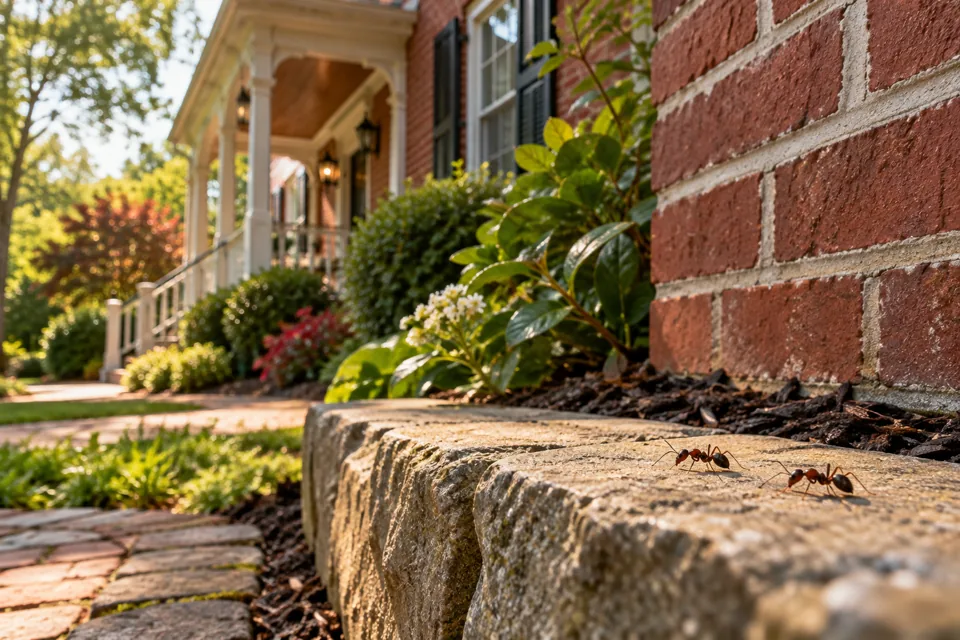
What you see matters: a trail across the kitchen counter, sawdust under a window or a mound by the patio points toward a particular plan. Use Call Now, say where the ants are, and you will be connected with an independent provider serving the Lynchburg area.
Ants you are likely to find in a house
Odorous house ants
Small, dark brown to black, with a rotten-coconut smell when crushed. Large colonies nest in wall voids, under sinks and in landscaping. They follow trails to sweets and water.
Pavement ants
A dark brown ant that nests beneath slabs and driveways and in sidewalk cracks, pushing up little mounds of soil next to the pavement. Workers get in through cracks in the slab and haul food back to the colony.
Carpenter ants
Large black or red-and-black ants that excavate damp or damaged wood. Piles of coarse sawdust-like frass, rustling in walls and winged ants in spring are signs of a nest nearby.
Argentine ants
A light to dark brown ant that forms huge connected colonies in warm regions, trailing up walls in long lines, especially after rain or dry spells.
Why bait beats spray for most ants
Spraying the ants you see kills the workers on the trail and leaves the colony behind. Slow-acting bait is carried back to the nest and shared, which reduces the queen and brood. Gel baits and granular baits are placed along trails, and a perimeter treatment with a non-repellent product adds a barrier outside.
Using repellent sprays or wipes may split one colony into several. Hold off on cleaning the trail with spray until the bait has done its work.
Moisture, wood and carpenter ant damage
Carpenter ants dig through wood rather than eat it, and they favor timber that leaks, condensation or rot have softened. The nest is usually close to the water source, whether that is a leaking roof, a failed window seal, a deck attached to siding or a gutter full of debris.
Dealing with the ants but not the water means soft wood and a problem that probably returns. You are getting the full answer only when the provider traces the moisture and tells you it has to be fixed.
Where ants get into the home
- Cracks in the foundation and slab expansion joints
- Tree limbs, shrubs and vines that touch the roof or siding
- Gaps around plumbing under sinks and behind appliances
- Door thresholds, weather stripping and window frames
- Utility lines, dryer vents and AC lines entering the wall
Ant prevention you can do this week
- Take out trash and recycling often, and rinse containers
- Fix dripping faucets and wet spots under sinks
- Seal visible gaps with caulk and add door sweeps
- Trim plants so nothing touches the house, and keep mulch a few inches from the foundation
- Store food, pet food and sugary items in sealed containers and wipe crumbs at night
Questions to ask before you agree to any ant control
- Which products, baits or devices will you use, and where will they go?
- How many visits are in the plan, and what happens if activity returns?
- What will you seal, remove or fix, and what stays my job?
- Who is on site, and can you show the state licence or applicator ID for the work?
- What will you write down for me: scope, exclusions, follow-up and product list?
How an ant control visit works, step by step
Pest visits that are done properly run in a fixed order, no matter which insect or animal is involved. Keep that order in mind when you talk to different companies, because a visit that leaves out the opening steps is the one to question.
- Inspection: the technician walks the outside first (foundation, vents, utility lines, eaves, fence lines, mulch) and then the inside (kitchen, bathrooms, garage, attic or crawl space).
- Identification: the species is named from the insect, droppings, damage or trail, because the right product and method depend on it.
- Plan: the provider explains what will be done, which products or devices will be used, and what you need to do before and after.
- Treatment or exclusion: the work is done in the places the inspection found, not by spraying every room.
- Follow-up: you get a date for the next check and a clear answer on what to report if activity returns.
What makes ant control different in Lynchburg
Lynchburg sits on hills along the James River in central Virginia, with many older brick homes on crawl spaces and basements. Virginia has a warm, humid summer and mild winters that keep termites, ants and carpenter bees active for much of the year.
Subterranean termites are common in the region, and wood in contact with soil or damp crawl spaces raises the risk. Fall brings stink bugs and cluster flies to sunny walls, and mice and rats look for warm crawl spaces and attics. Ask any provider how these local details change the plan for your address, because a method that works in one climate or housing style can fail in another.
Ant control across Lynchburg and nearby cities
Pest Control Lynchburg VA covers Lynchburg, Virginia and the surrounding area. Calls and requests also reach providers serving Forest, Madison Heights, Bedford, Amherst and Appomattox. Coverage is confirmed address by address, so say your ZIP code when you call.
To get going, press Call Now at the top of any page and tell the person who answers what you found. That puts you through to an independent provider nearby, and the provider verifies your address, looks the property over and writes up the scope.
Related help in Lynchburg
If this is not quite your situation, these pages cover the neighboring questions: Rodent control; Comparing pest control quotes; Pest inspection; Cockroach control. The service area list shows every nearby city and ZIP code covered.